Beyond the Hype:
The Era of Orchestration
Has Arrived
The pilot phase is over. Generative AI leadership is no longer about experimentation; it is the new C-Suite essential. The defining competitive advantage now belongs to leaders who can orchestrate autonomous systems at enterprise scale.
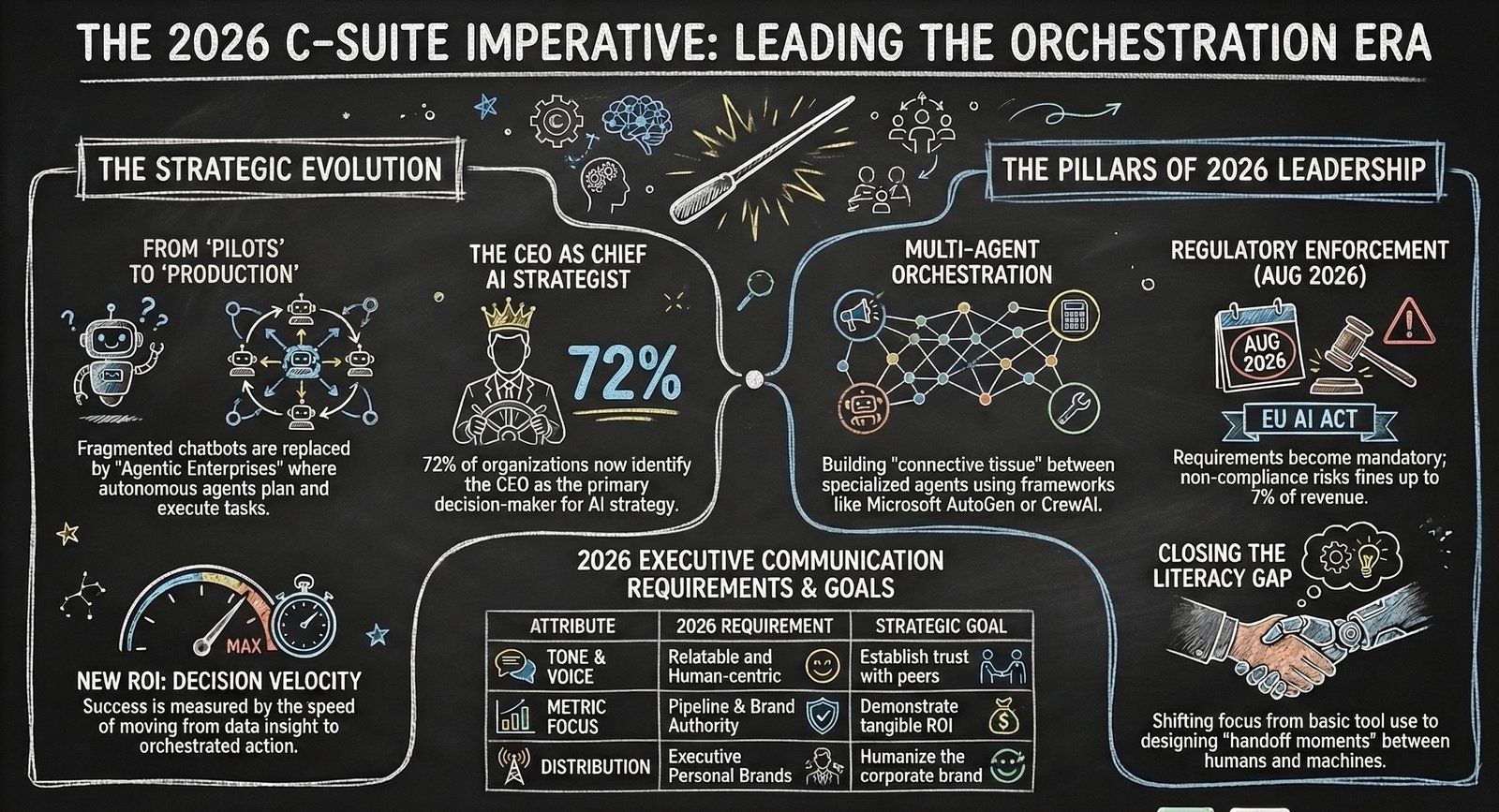
From Pilots to Production:
The Inflection Point Is Now
As of Feb 2026, the industry has reached saturation with standalone generative tools. The critical shift in competitive advantage is no longer about having access to AI models; it is about orchestrating them to accelerate decision-making at every layer of the enterprise.
The transition of generative artificial intelligence from speculative experimentation to foundational enterprise infrastructure has reached a decisive moment. For the modern C-suite, the "pilot phase", characterized by fragmented chatbots and isolated AI projects, is effectively over, replaced by a strategic mandate focused on systematic orchestration and integration.
Leadership is no longer measured by the volume of AI adoption but by the discernment of its application and the resilience of the governance frameworks that sustain it. The era where technical proficiency in prompt engineering defined executive credibility has been superseded by a far more demanding requirement: sophisticated systems thinking.
Success in 2026 is defined not by how many AI tools an organization has deployed, but by how fast it can move from data insight to orchestrated action.
The Pilot Trap and How to Escape It
Organizations failing to move past "chatbots as novelty" are experiencing diminishing returns on their early AI investments. The primary barrier is not technology; it is organizational. Security reviews stall deployments, compliance concerns freeze workflows, and siloed teams run disconnected experiments that never scale. The solution is a shift to composable architectures: modular, API-driven frameworks that embed AI capabilities into existing ERP, CRM, and operational systems.
The New ROI Metric: Decision Velocity
Leaders are moving beyond traditional cost-saving metrics. Decision Velocity, the speed at which an organization moves from an AI-generated insight to an automated, orchestrated action, has become the primary measure of competitive standing. In the volatile markets of 2026, this velocity is the new frontier of market leadership.
The Four Mandates Every
Executive Must Own in 2026
Navigating the Orchestration Era requires mastery across four distinct domains. These are not IT priorities, they are board-level imperatives with direct implications for revenue, compliance, and cultural resilience.
Strategic Alignment
Solving the "Integration Tax" by linking AI capabilities directly to measurable business constraints via composable architecture.
Orchestration Mandate
Building the Agentic Enterprise where autonomous agents plan, reason, and execute, with orchestration as the connective tissue.
Governance & Risk
EU AI Act enforcement begins August 2026. Non-compliance risks fines of up to 7% of global annual revenue.
Closing the Literacy Gap
Shifting focus from basic tool use to designing intentional "handoff moments" between human experts and autonomous agents, at every level of the organization, from the Board to the front line.
Pillar I: Strategic Alignment & The Death of Shiny Object Syndrome
The discipline of 2026 is asking: "Which actual business constraint is AI solving?" The leaders pulling ahead are not those with the largest AI budgets, they are those reallocating those budgets toward composable, modular frameworks that link AI capabilities directly to legacy infrastructure.
| Phase | Characteristic | Strategic Focus |
|---|---|---|
| Followers (15%) | Limited to pilots; cautious; high anxiety | Waiting for proven competitor success |
| Pragmatists (70%) | Heavier investment; steady upskilling momentum | Aligning with market trends; people + tools |
| Trailblazers (15%) | Decisive, large-scale; extensive workforce transformation | Reimagining business models; AI-first competition |
Pillar II: The Orchestration Mandate & the Agentic Enterprise
The most significant technological trend for the next six months is the rise of the Agentic Enterprise, an organizational model where autonomous AI agents plan, reason, and execute tasks with minimal human intervention. These systems allow for task decomposition, where complex organizational goals are broken into sub-tasks handled by agents specifically tuned for each function.
| Framework | Category | Key Business Advantage |
|---|---|---|
| Microsoft AutoGen | Multi-agent conversational AI | Scalable distributed networks; ideal for R&D and code generation |
| CrewAI | Role-based orchestration | Sequential and hierarchical task management; maps easily to org workflows |
| LangGraph | Modular, agent-centric | High customization; stateful workflows; human-in-the-loop friendly |
| PwC Agent OS | Enterprise Operating System | Vendor-agnostic agents; prioritizes speed over scale |
| UiPath Maestro | BPMN-based orchestration | Coordinates agents, RPA bots, and humans; deep process intelligence |
Pillar III: Governance, Risk & Sovereign AI
In August 2026, EU AI Act requirements become mandatory enforcement milestones. Non-compliance exposes organizations to fines of up to 7% of global annual revenue, a figure that transforms AI governance from a legal department concern into a CFO-level financial risk.
Estimated global market influenced by sovereignty requirements by 2030, representing up to 40% of total AI spending. (McKinsey, 2026)
Organizations are now prioritizing Sovereign AI Ecosystems; connecting local energy, compute, and data platforms into a secure, domestic backbone.
Pillar IV: Closing the Literacy Gap
In 2026, AI maturity is measured not by the volume of automated tasks, but by the discernment of when not to use AI. Organizations that intentionally redesign roles around human-AI collaboration, rather than simply automating existing processes, are significantly more likely to exceed ROI expectations and improve employee performance.
The key design challenge is mapping out "handoff moments", the points where work passes between humans and autonomous agents. These transitions are precisely where systems most frequently fail, and where skilled leadership creates the most durable competitive advantage.
| Level | 2026 Priority |
|---|---|
| Board | Ethical oversight & risk governance |
| C-Suite | Orchestration strategy & ROI delivery |
| Management | Mixed-team leadership & handoff design |
| Workforce | Prompt precision & tool experimentation |
Q2–Q3 2026: Sector by Sector
Select a sector to explore developing demands and the specific orchestration milestones expected over the next six months.
| Sector | Primary AI Focus | Anticipated Q2–Q3 Impact |
|---|---|---|
| Financial Services | Autonomous finance & risk-based ROI | 40% improvement in forecasting accuracy and speed |
| Manufacturing | Physical AI & cobots on assembly lines | 80% adoption rate; shift to autonomous logistics |
| Healthcare | Orchestrated AI care navigation | Closure of the 94.7% preventive care gap |
| IT & Telecom | Agentic AI as force multiplier | 50% reduction in daily operational tasks |
| Retail & E-commerce | IoT-driven demand-led fulfilment | Real-time AI-powered supply chains |
| Event | Date & Location | Primary Focus |
|---|---|---|
| NVIDIA GTC 2026 | Mar 16–19 · San Jose | Inference, Agentic AI, machine intelligence |
| HumanX 2026 | Apr 6–9 · San Francisco | AI and human potential; executive summit |
| Generative AI Summit | Apr 13–15 · London | Workforce transformation, EU AI Act compliance |
| Gartner Data & Analytics | May 11–13 · London | Scalable enterprise architecture, ML investment ROI |
| Databricks Data + AI | Jun 15–18 · San Francisco | Data engineering, governance, open-source agents |
| The AI Conference 2026 | Sep 29–Oct 1 · San Francisco | Applied AI for scale-ups, neural architecture nuances |
Ready to Lead the Orchestration Era?
Understanding the landscape is the first step. The leaders who will define 2026 are those who have already built a structured, validated command of Generative AI strategy; not through trial and error, but through a rigorous, peer-recognized framework designed for senior decision-makers.
The Generative AI Leader Certification equips C-suite executives and senior managers with the strategic vocabulary, governance frameworks, and orchestration fluency required to drive enterprise-wide AI transformation and earn the credibility to lead it.
Explore Certification →Designed for VPs, Directors & C-Suite · Self-paced · Peer-recognized · Immediately applicable
Driving vs. Being Driven
In 2026, the "Chief AI Officer" title is becoming redundant. Every leader is an AI leader. The next six months will separate Trailblazers reimagining business models from Followers still debating budgets.
Confuse tactical AI proficiency with strategic organizational readiness. Mastering isolated model outputs is a temporary edge that ignores the long-term risks of unmanaged shadow AI and fragmented governance.
Position yourself as a systems architect. Focus on orchestration fluency by designing resilient, compliant workflows. This is the new executive literacy required to turn AI potential into sustainable ROI.
Establish a culture that treats AI as a high-performance teammate; this requires clearly defined roles, seamless handoffs, and the rigorous accountability standards found in the ISO/IEC 42001:2023 framework and knowledge from Generative AI Leadership certifications.
The Mandate for the Modern C-Suite
The reality of 2026 is that AI success is a top-down endeavor. C-level executives who are deeply engaged with AI strategy are 12 times more likely to rank among the top 5% of companies winning with AI innovation.
Successful Gen AI leadership requires moving past the "cheerleader" phase to secure a mandate for change that includes the necessary tools, authority, and resources. It means shifting from a static digital transformation roadmap to an evolving strategy that grows with the organization's AI capabilities: one anchored in real governance, real literacy, and real orchestration architecture.
As we move into the second half of 2026, the most effective leaders will be those who combine technical fluency with ethical judgment, treat AI as a strategic partner, and lead a cultural transformation that grounds every algorithmic insight in the messy reality of human context.
The orchestration era has arrived. The C-suite must now lead the symphony.
The executives referenced in this briefing share a single, defining trait: structured and deliberate AI leadership development. These leaders, who are 12 times more likely to win, understand that intuition is no substitute for a formal framework. The Generative AI Leader Certificate is where that journey starts; it provides the definitive path to mastering the orchestration, ethics, and governance required to lead in 2026.
Want to connect or collaborate?
Get in Touch